Column Vol. 5 “Eliminating the ‘Wind’ — The Ultimate Comfort of the ‘PS Radiant Heating & Cooling System'”
Ono from Wald
In this column series, we began with our core philosophy (Vol. 1) and then discussed how we elevate the performance of the home’s “shell” itself, using “DAKO” high-performance windows (Vol. 2) and “PAVATEX” breathing insulation (Vol. 3).
When we build a house that functions like a high-performance thermos—preventing heat from escaping or entering—the energy required for heating and cooling becomes minimal. However, if we make the wrong choice for that “finishing touch,” the HVAC system, all that hard-earned comfort can be ruined.
The Problem with “Wind”: Air Conditioners
The heating and cooling system most familiar to everyone is the “air conditioner.”
Air conditioners are “forced convection” systems. They work by creating strong drafts to circulate air and forcibly adjust the room temperature. This “wind” is the source of much discomfort:
- The floor is cold, but your face feels hot (uneven temperature).
- Skin and throat feel dry (excessive dryness).
- The draft blows directly onto your body.
- The operating noise is intrusive.
- Dust and allergens are kicked up and circulated throughout the room.
Our Solution: “Radiant” Heating & Cooling
To fundamentally solve these problems and achieve “truly premium comfort,” we employ a system based on a completely different principle from conventional air conditioners. That system is the “PS Radiant Heating & Cooling System.”
PS heating and cooling is a “radiant” system that uses no wind at all.
“Radiation” is the phenomenon of heat being transferred directly to objects via electromagnetic waves (far-infrared rays). When you feel the warmth of the sun in a “sun spot” or stand in front of a wood stove and feel warmed to your core, you are experiencing radiant heat.
The PS system works by circulating cold water (in summer) or hot water (in winter) through beautifully designed heater panels installed in the room.
In winter, the far-infrared rays emitted from the panels do not heat the air; they directly warm the walls, ceiling, floor, and the people in the room. Conversely, in summer, the cool panels “absorb” the heat being radiated from the walls and people.
The PS Difference: A New Level of Comfort
The indoor environment this system creates is on a completely different level from that of an air conditioner.
- Absolute Silence, with No Wind or Noise
Because there is no fan, there is no unpleasant draft and no operating noise. Dust and mold spores are not circulated, achieving a quiet, clean environment ideal for those with allergies, much like being in a library. - Uniform, Sun-like Warmth
Radiant heat warms the entire house evenly, so there is almost no temperature difference between the floor and the ceiling. You are free from the “hot head, cold feet” phenomenon common with A/C heating, and are instead enveloped in a comfort that feels like a natural sun spot. - Preserves Humidity, Prevents Dryness
Because PS heating does not directly heat the air, it does not strip the room of its humidity. When combined with the moisture-buffering capabilities of the wood fiber (discussed in Vol. 3), it prevents excessive dryness in winter, maintaining an environment that is gentle on the skin and throat.
Of course, this system has its technical aspects. For example, cooling the panels too much during summer operation could cause condensation to form on their surface. PS has solved this problem with advanced technology called “Dehumidifying Radiant Cooling (HR-C),” a system that controls humidity and provides radiant cooling simultaneously.
Conclusion: The “Breathing Home” as a Complete System
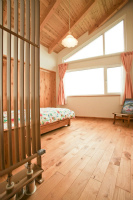
Our home-building philosophy, which began with the mission to “prevent condensation,” reaches its complete form by eliminating heat transfer with “DAKO” windows, allowing the walls to breathe with “PAVATEX” insulation, and finally, eliminating the “wind” to achieve a premium indoor environment with “PS Radiant Heating &Cooling.”
All of these elements function as one cohesive system under our guiding philosophy of “Breathability.”
Over five volumes, I have discussed the core of Wald’s home-building philosophy. I hope this series has provided you with an opportunity to think about what “true comfort” means for your own home. Thank you for reading.